

Before and After: What Poor Translation Looks Like Next to NAATI Compliant Work
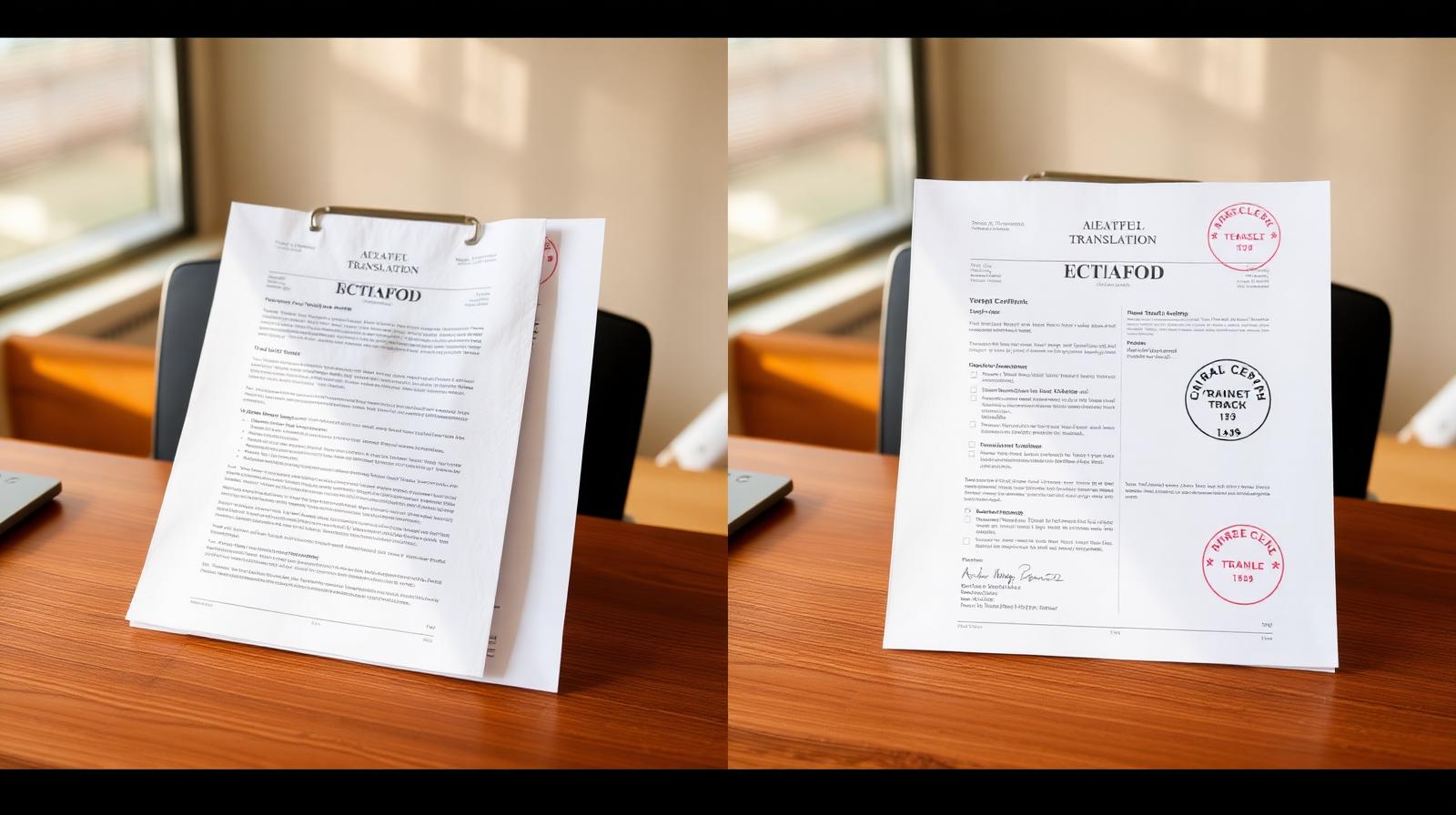
Place a poor translation next to a compliant one on the same desk and the difference jumps out before a single word is read. Layout, certification block, stamp placement and source attachment all signal whether a file will move through assessment or sit in a queue waiting for clarification. This guide walks through five real document scenarios we handle every week, shows what the weak version looks like, then sets it beside a naati certified translation produced to Australian standards. Use it as a visual reference before you commission any document for a visa, university or government submission.
Why Side by Side Matters
An Australian case officer reads dozens of translated packs a day. The first scan is visual and lasts under ten seconds. The eye lands on the certification block, the stamp, the signature and the binding of source with translation. If those anchors are missing or sloppy, the file gets routed for further information before the body text is checked. A confident pack reads as a confident applicant, and the document layout does most of that talking for you.
The compliance scorecard
Five criteria decide whether a translation passes a first scan. Each row is scored on a weak version and a compliant version of the same source document.
| Criterion | Poor version | Compliant version | Why it matters |
|---|---|---|---|
| Practitioner identity | No name, no CPN | Full name plus CPN on every page | Proves accountability |
| Certification statement | Single word "certified" | Formal accuracy declaration | Confirms authorship |
| Stamp and signature | Missing or photocopied | Original stamp with live signature | Confirms physical issue |
| Layout fidelity | Free flowing paragraph | Mirrors source layout and tables | Speeds assessment |
| Source binding | Translation alone | Bundled with source scan | Allows verification |
Specimen One: Birth Certificate
The poor version arrives as a typed Word document. The translator has rewritten the page as a paragraph of plain text. The seal is described in a footnote rather than drawn in place, the parents' names appear in a single block without field labels, and the word certified sits at the top in bold with no signature beneath it.
The compliant version mirrors the source. Each field carries its label, the seal appears as a bordered box marked with the issuing authority, and the certification block at the foot of the page lists the practitioner name, the Certified Practitioner Number, the language pair and a signed declaration that the translation is a true and accurate rendering of the source. The same page bundles the colour scan of the original birth certificate behind it.
Specimen Two: Academic Transcript
Academic transcripts are dense and unforgiving. The poor version omits the grading legend, flattens the table into a list, and translates only the subject names. The result strips the document of context. An assessor cannot match course weightings, credit hours or grade bands to the Australian equivalents because the structure of the source is gone.
The compliant version keeps the table layout, preserves the grading legend, retains the original course codes alongside the English subject names, and adds a translator note clarifying the grade scale. For dedicated examples of how transcripts should be handled, the academic transcript translation service page shows the formatting standard applied to every order, including the certification block that travels with each page.
Specimen Three: Police Clearance
Police clearances rely on stamps, reference numbers and dates. The poor version captures the body text but crops the reference number out of the header and omits the official seal from the foot of the page. A reader cannot trace the certificate back to the issuing authority. The translation is technically present yet evidentially weak.
The compliant version reproduces the seal as a clearly marked box, preserves the reference number in its original position, mirrors the issuing office address and notes the date of issue in the original format with a clarifying note in brackets. The translation pack binds the source scan behind every translated page so the case officer can match each stamp to its rendering.
Specimen Four: Marriage Certificate
A poor marriage certificate translation often misses the witnesses, the celebrant identifier or the bilingual seal on the reverse. Names appear with a different transliteration to the passport, which alone can trigger an identity flag. The certification block, when present, reads as a one line stamp without the formal accuracy declaration required for official document translation services.
The compliant version locks in the passport spelling for every named party, captures witnesses and celebrant in full, mirrors the bilingual seal in place, and closes with the full certification statement. Authoritative reference on what Australia accepts at the translator level sits in the NAATI Certification Scheme overview.
Specimen Five: Bank Statement for Visa Financials
Bank statements support financial capacity claims for student and visitor visas. The poor version converts amounts silently into Australian dollars, omits the running balance and skips the closing statement footer. The translation looks tidy but the figures cannot be reconciled with the source. The compliant version retains the original currency, mirrors the column structure including running balance, preserves headers and footers in place, and adds a translator note where any abbreviation needs context.
Visual Anatomy Diff
| Element | Poor version | Compliant version |
|---|---|---|
| Header block | Missing | Present |
| Translator declaration | Missing | Present |
| CPN line | Missing | Present |
| Stamp placement | Off page | Anchored |
| Page numbering | Absent | Page X of Y |
| Source attachment | Not bundled | Bundled PDF |
| Font legibility | Mixed | Consistent |
| Date format | Silently changed | Preserved with note |
By the numbers
Around one in three rejected migration packs we review for replacement work cite translation evidence as a contributing factor. The Department of Home Affairs publishes its translation expectations on the translating your documents guidance page, and a compliant pack mirrors every requirement on that page in a single read.
Five Tell Tale Signs of a Poor Translation
- The certification block is a single word or a sticker rather than a full declaration.
- The translator name and Certified Practitioner Number are absent from the page.
- The layout flattens tables, seals or stamps into running paragraph text.
- Names appear with different spellings across documents in the same pack.
- The translation arrives alone with no scan of the source document attached.
A standard certified extract through Ethnic Translations is $44.95 + Service Fee. The compliant version costs the same as the poor version, so the only sensible choice is the one that survives the first scan. If you want to confirm the credentials of any practitioner before commissioning the work, the companion guide on how to verify a NAATI translator walks through the directory checks and red flags worth knowing.
A compliant translation reads as confident evidence. A poor one reads as a problem the case officer has to solve.
About the Author
Amelia Ross — Amelia Ross is a senior translation reviewer at Ethnic Translations who audits certified packs against Australian government and university lodgement standards every week.